

Midtown Madness: The 90s Racing Game That Invented Open-World Driving
 By: Edward
Last updated: 10 March 2026, 10:09 am



In May 1999, most racing games gave you a track, a car, and a countdown. Midtown Madness gave you Chicago. Not a corridor of barriers and grandstands, but an open rendition of a real American city — with traffic obeying signals, pedestrians going about their day, drawbridges rising and falling on their own schedule, and weather that slowly piled snow onto the roads and changed how your car handled. It was a different kind of racing game, and it arrived before anyone had quite worked out how to make one.

The Game That Wasn't Supposed to Exist
The origin of Midtown Madness is a small piece of gaming history worth knowing. The concept came from two Microsoft employees who were trying to cross a crowded street in Paris and found themselves thinking about what it would feel like to drive through a city like that in a game. They brought the idea to Angel Studios, a San Diego developer that had been trying to sell Microsoft a 3D vehicle simulator. Angel Studios was initially hesitant — the scope was daunting — but on July 3, 1997, they signed the contract. Prototype development started in September 1997, and the finished game shipped to retailers on May 18, 1999. Eighteen months to build an open city racing game from scratch, on hardware that had never attempted anything like it.

Angel Studios was not a household name in 1999, but they were technically serious. They had built their own engine — ARTS, Angel Real Time Simulation — and their own suite of in-house tools for constructing and populating the city. The City Tool created the physical environment. The GenBAI Tool processed the raw data into the AI map that every car, pedestrian, and police vehicle in Chicago would use at runtime. This wasn't licensed middleware bolted onto a racing framework. It was a custom-built system, designed from the ground up to simulate a living urban environment.
Chicago as a Non-Player Character
The city of Chicago was chosen deliberately. Its famous car chases in films — The Blues Brothers being the obvious reference — gave it a cultural resonance that suited the game's tone. The development team asked Chicago residents to playtest the game to verify the recreation's accuracy, and PC Gamer reported at the time that the result was largely faithful, with some landmarks repositioned to improve gameplay flow.
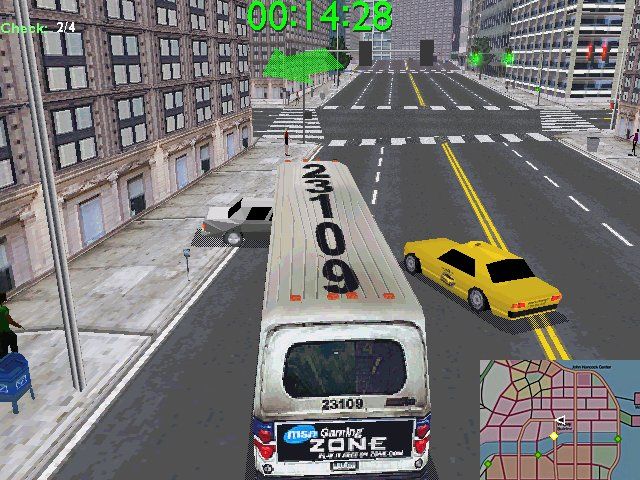
What the game captured was less the map and more the feeling. The Willis Tower (then the Sears Tower) on the skyline. The 'L' elevated railway threading through the streets. Wrigley Field. Soldier Field. The Chicago-style drawbridges going up and down independently of anything the player was doing — and yes, you could time your run to launch off one as it rose. The city had a texture that racing games of the time simply didn't attempt.
Traffic followed its own logic. Drivers obeyed traffic lights, changed lanes, used indicators, and reacted to collisions. Some drove cautiously; others cut you off and shouted. Pedestrians walked the sidewalks, crossed at lights, and — in a detail that required a specific engineering solution — dove clear when you mounted the curb. Microsoft had asked Angel Studios to ensure players couldn't run pedestrians over. The solution was to build full 3D pedestrian models with behavioral states: a far zone where they'd turn to face an oncoming vehicle and enter an "anticipate" state, and a near zone where they'd either hug a nearby wall or dive in the opposite direction of your vehicle's momentum. Sometimes, Joe Azdima — the AI programmer who built the entire system — noted that a superhuman boost in dive speed was needed when the player was going fast enough. The pedestrians survived regardless.
The AI Under the Hood
What made Midtown Madness feel alive wasn't just the visual design of Chicago — it was the AI architecture underneath. Azdima's system divided the city into roads, intersections, and open areas, each represented as software objects with their own logic. Ambient traffic drove on Hermite spline curves that updated smoothly as vehicles moved between road segments. Each vehicle had its own speed parameters — a random variance above or below the posted limit — and followed a four-stage approval process before entering any intersection: checking the traffic control state, consulting the accident manager, confirming the next road had capacity, and resolving conflicts with other vehicles trying to cross simultaneously.
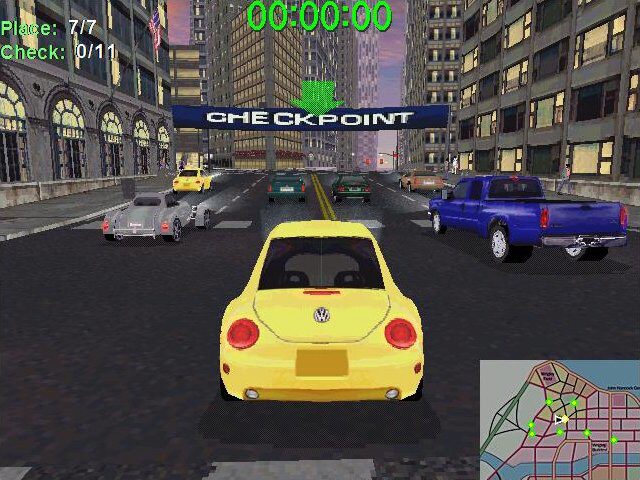
The opponent AI — the computer-controlled racers — used a route-planning system that calculated up to three alternative paths around every anticipated obstacle, building a tree of options and selecting the one that stayed on the road, avoided blockages, and required the least turning. When a racer got stuck, it reversed, realigned with the road, and resumed. When it needed to navigate a sharp corner, it calculated the maximum safe velocity using a friction-based formula and slowed accordingly.
None of this was visible to the player in any direct way. But it was why Chicago felt like a city rather than a backdrop.
Four Ways to Drive
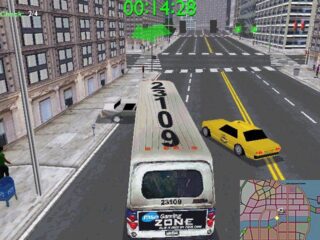
Midtown Madness offered four distinct modes. Blitz was a time-attack through checkpoints. Circuit cordoned off sections of the city into something resembling a traditional race. Checkpoint combined elements of both and introduced police vehicles and full traffic into the mix. And Cruise — the mode that many players spent most of their time in — simply let you drive. No objectives. No clock. Just Chicago.
The freedom extended to the races themselves. Checkpoints defined where you needed to go, but not how to get there. Every shortcut, alley, and gap between buildings was a legitimate option. The city rewarded exploration and punished players who assumed there was only one route. This was explicitly intentional — project director Clinton Keith described it as adding an "element of discovery" to a genre that had always been about following the line.
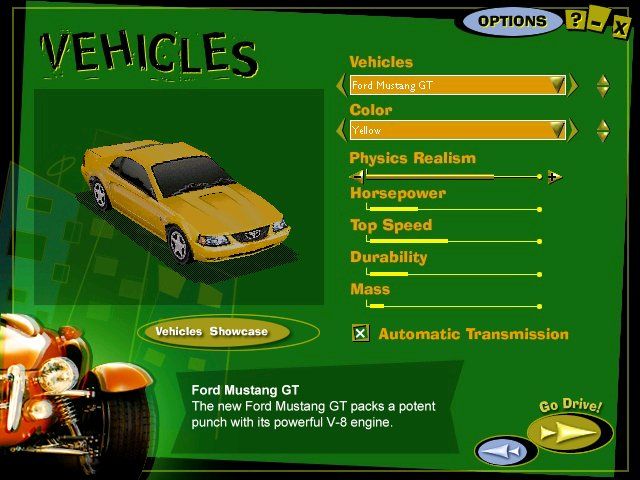
The game shipped with ten cars, five available from the start and five unlockable. The roster ran from a Volkswagen New Beetle and a Ford Mustang GT to a city bus and a Freightliner Century truck. Manufacturers had given their approval for the likenesses — Ford for the Mustang and F-350, Volkswagen for the Beetle — and the audio team had recorded actual engine sounds by strapping microphones to the cars and having Kiki Wolfkill, one of the few developers with track racing experience, drive them around a circuit.

Weather and time of day were fully variable: sunrise, afternoon, sunset, and night; sunny, cloudy, rainy, and snowy. Snow accumulated on the roads over the course of a race, progressively degrading traction. After completing any race, players could adjust these conditions freely before replaying it.
The game also supported multiplayer over LAN, the internet, and a serial cable, including a Cops and Robbers mode — a capture-the-flag variant in which two teams tried to steal each other's gold and return it to their own hideout. It was more ambitious than the multiplayer in most racing games of its year.
The Legacy
Midtown Madness sold over 100,000 copies in the US alone by April 2000, and received strong reviews: IGN gave it 8.4, PC Gamer US 90%. The criticism, where it existed, centred on frame rate issues and the visual quality of vehicles in the distance — limitations of 1999 hardware rather than design failures.
Two sequels followed. Midtown Madness 2, developed again by Angel Studios and released in September 2000, expanded the formula with San Francisco and London as playable cities — the latter requiring a complete inversion of the AI's lane logic, since London drives on the left. Midtown Madness 3 followed in 2003, developed by Digital Illusions CE for the Xbox.
In 2000, Angel Studios and Rockstar Games released Midnight Club: Street Racing for PlayStation 2 — a direct evolution of the Midtown Madness concept applied to street racing culture. Its success launched the Midnight Club series. In November 2002, Angel Studios was acquired by Rockstar Games and became Rockstar San Diego, the studio that would go on to develop Red Dead Redemption.
The line from that Paris street crossing in 1997 to Red Dead Redemption's open world in 2010 is not a straight one, but it runs through Chicago. Midtown Madness was where Angel Studios learned how to make a city breathe — and that turned out to be a skill worth having.
If you want to experience it, the game is available to download for free on GamesNostalgia. Pick a car, find a drawbridge, and wait for it to go up.
Originally published in 2017. Revised and expanded in March 2026.