
Retro games, abandonware, freeware and classic games for PC and Mac


Author: GN Team - Published: 30 April 2026, 2:29 pm
Micro Machines: Turbo Tournament '96 is a top-down racing game developed and published by Codemasters, released in 1995 for the Sega Genesis/Mega Drive. It is the third entry in the Micro Machines series, following Micro Machines and Micro Machines 2: Turbo Tournament, and refines the formula of its predecessors while adding a handful of new features — most notably a Construction Kit that lets players build their own tracks.
The concept remains as charming as ever: tiny vehicles racing across oversized everyday environments — kitchen tables, bathroom floors, sandboxes, garden paths — viewed from a top-down perspective. Turbo Tournament '96 delivers 54 tracks set across the same imaginative variety of locations that made the earlier games so memorable. Dump trucks, hovercrafts, Formula 1 cars, and other vehicles all handle differently, and learning to manage the hovercraft sections in particular — notoriously fast and difficult to control — remains one of the game's most demanding challenges.
Read More
Author: Adam - Published: 25 April 2026, 2:10 pm
Michael Jackson's Moonwalker is an action platformer developed and published by Sega, released for the Sega Genesis and Master System in 1990. It is based on the 1988 film of the same name — part concert film, part fantasy — in which Jackson plays a superhero who rescues kidnapped children from a villain named Mr. Big, portrayed by Joe Pesci. The Genesis/Mega Drive version is a distinct game from the arcade original, redesigned for the home hardware, and it became one of the more memorable licensed titles of the 16-bit era.
Read More
Author: Tasha - Published: 21 April 2026, 9:08 pm
The Lost World: Jurassic Park is an action game developed by Appaloosa Interactive and published by Sega, released in 1997 for the Sega Genesis/Mega Drive. It is based on Steven Spielberg's film of the same year and the Michael Crichton novel that preceded it, and exists as a notably different experience from the PlayStation and Saturn versions released alongside it — not a port, but a separate game built specifically for the 16-bit hardware.
Where the PlayStation version allowed players to take on the role of a T-rex, the Genesis game casts them exclusively as a hunter stranded on Isla Sorna, the dinosaur-populated island of the film. The goal is simple: escape the island alive. Across 19 stages viewed from a top-down perspective, players navigate dense jungle environments while managing a roster of weapons that includes tranquilizer darts and pistols, choosing between them depending on the situation. Fallen hunters scattered across the levels can be looted for energy, making exploration worthwhile beyond simple navigation. When supplies run low, players can call for airdrops — a practical system that adds a light strategic layer to what is otherwise direct action gameplay.
Read More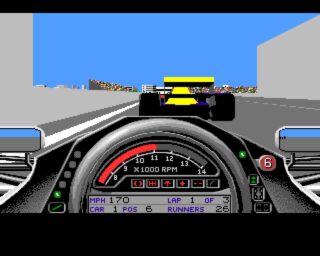
Author: GN Team - Published: 19 April 2026, 1:12 pm
Formula 1 Grand Prix is a racing simulation developed by Geoff Crammond and published by MicroProse, released for the Amiga and Atari ST in 1991. The MS-DOS version was released in 1992. In North America, it was published in 1992 under the title World Circuit. It is the first entry in what would become Crammond's defining series, and one of the most ambitious racing simulations ever attempted on home computer hardware of the era.
Crammond came to the project already deep into Formula 1. His earlier work on Revs for the BBC Micro and Commodore 64 had given him a rigorous understanding of how to translate real circuit data into a game, and that foundation is evident throughout. All 16 international Grand Prix circuits of the 1991 season are included, each modeled with genuine care for their real-world geometry. Players can tackle them in a quick race, a single Grand Prix, or a full championship. The 18 teams and 35 drivers reflect the 1991 season in terms of performance, though the game uses fictional names throughout — a licensing limitation that players could work around by manually editing and saving team and driver names.
Read More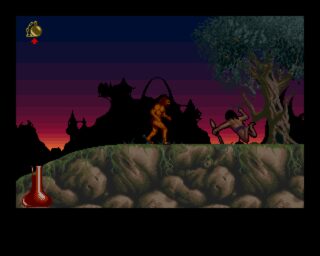
Author: GN Team - Published: 19 April 2026, 1:01 pm
Shadow of the Beast II is an action platformer developed by Reflections Interactive and published by Psygnosis, released in 1990 for the Amiga. It is the direct sequel to Shadow of the Beast, one of the most visually celebrated games of the Amiga era. The game was designed and programmed by Martin Edmondson, with the soundtrack composed by Tim Wright, who replaced David Whittaker from the original.
The story picks up immediately after the events of the first game. Aarbron, the protagonist, has partially broken free from the curse that transformed him into a monstrous servant of the Beast Lord Maletoth — he is now in half-beast form, neither fully human nor fully creature. His sister has been kidnapped and taken to the lands of Kara-Moon, and he must venture through a hostile world to find her. The narrative is again told primarily through the manual rather than in-game, but the premise gives the journey a more personal, urgent quality than the original's revenge arc.
Read More
Author: GN Team - Published: 18 April 2026, 1:04 am
World Court Tennis is a sports game developed by Namco and published by Hudson Soft, released for the PC Engine and its North American equivalent, the TurboGrafx-16, in 1989. It is one of the most unusual sports games of its era — on the surface a tennis game, but underneath it hides a fully functional RPG quest mode that makes it unlike almost anything else in the genre.
The tennis gameplay itself is solid and enjoyable. Viewed from behind the court in a pseudo-3D perspective, the game supports singles and doubles matches, with a second-player option that makes multiplayer fun. You choose from a roster of characters based on real tennis players of the era — including Boris Becker, John McEnroe, and Ivan Lendl — though the differences between them are largely aesthetic rather than statistical. The controls are simple: the directional pad moves your player around the court, and two face buttons produce different shot types — a powerful drive and a higher lob. Serving can be tricky, with the power shot producing frequent faults until you learn the timing, but the ball physics feel noticeably more natural than in many console tennis games of the period, allowing for dynamic rallies and proper baseline play. Compared to Super Tennis on the SNES or Super Tennis Champs on the Amiga, World Court Tennis has a more arcade-like feel, while Final Match Tennis — also on the PC Engine — offered a somewhat more simulation-oriented alternative on the same hardware.
Read More Amiga
Amiga Commodore 64
 MS-DOS
 Windows 9x