

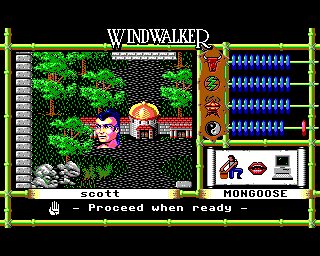




Nevertheless, Windwalker remains a highly original title that was appreciated by many at its time, perhaps mainly due to its very approachable difficulty level (a rarity at the time). Exploration occurs from a top-down, isometric perspective reminiscent of Ambermoon (though with graphics not comparable to Thalion's masterpiece). The game world feels very "alive," featuring a day-night cycle and populated with characters and enemies that appear to follow their own logic. The story and atmosphere draw inspiration from Japanese fantasy, infused with a touch of Eastern philosophy and religion.
When it comes to combat, Windwalker employs a "dueling" mode with a side view that resembles games like Budokan: The Martial Spirit, to name one of the many one-on-one fighting games. This is a decidedly original choice that may or may not appeal to everyone. Unfortunately, the combat sections are slow and certainly not comparable to the best fighting games, even though the animation of the sprites is well done. Players can choose between a "concentration" mode, which resembles turn-based combat, and real-time combat.
Windwalker may not go down in history as the best game of the 1980s, but if you have an appreciation for Japanese settings, martial arts, and RPGs with rich worlds to explore, it's worth taking a look.


 Download for PC
 Download for Mac