




Warcraft: Orcs & Humans is a real-time strategy game developed and published by Blizzard Entertainment — then still known as Silicon & Synapse — released for MS-DOS in 1994. The Macintosh version followed in 1995.
The game is set in the fantasy world of Azeroth, where the human kingdoms face an invasion from a mysterious race of Orcs emerging from a dark portal. You can play as either side, with 12 scenarios per faction, each telling the story from a different perspective. The setting was relatively simple by later Warcraft standards, but it established the lore and the rivalry between Humans and Orcs that would define the franchise for decades.
The game was produced and programmed by Patrick Wyatt, with art direction by Sam Didier, whose distinctive fantasy style would go on to define the visual identity of Blizzard games for years. Ron Millar contributed to the game design, and Mike Morhaime — one of the co-founders of Blizzard — personally wrote the modem networking code that enabled two players to compete over a dial-up connection. For 1994, this was a significant technical achievement.
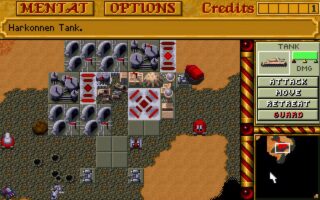
The team was directly inspired by Dune II: The Battle For Arrakis, which they played obsessively during lunch breaks and after work. As Wyatt later wrote, the real-time strategy foundations that Dune II had established were the clear starting point — but the Blizzard team had a list of things they wanted to improve. The most notable innovation Wyatt introduced was click-and-drag multi-unit selection: for the first time, players could draw a rectangle on screen to select a group of units rather than clicking on them one at a time. Warcraft was one of the first games to use this interface mechanic, which became standard in every RTS that followed. The final game limited selection to four units at a time — a design decision that was debated internally and later increased to nine in Warcraft II: Tides Of Darkness.
One notable limitation of Warcraft I was the road-building requirement: players had to lay roads before constructing buildings, which made base management more rigid than it needed to be. The team acknowledged this as the game's biggest flaw, and it was one of the first things removed in the sequel.
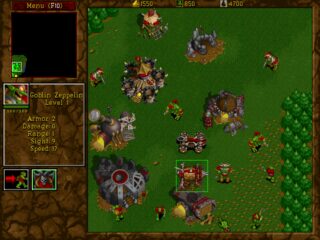
Visually, the game used a top-down perspective with colorful sprite-based graphics that suited its fantasy setting well. The interface was straightforward, though managing larger armies could feel slow by later standards — partly a consequence of the unit selection limit.
Warcraft: Orcs & Humans was a commercial success and helped bring real-time strategy games to a mainstream audience. It launched one of the most beloved franchises in gaming history, leading directly to Warcraft II: Tides Of Darkness and eventually World of Warcraft, one of the most successful games ever made.
 Review by: Dean Hammond


 Search on GOG
 Search on Steam
 Search on GamesVoyager