

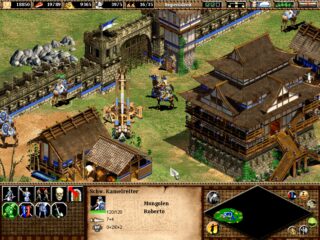




Age of Empires II: The Age of Kings is a real-time strategy game developed by Ensemble Studios and published by Microsoft in 1999 for Windows and Macintosh. It is the sequel to Age of Empires, one of the most successful strategy games of the 1990s, with an expansion, Rise of Rome, released between the two.
The game was led by Ian Fischer as lead designer, with Bruce Shelley — co-founder of Ensemble Studios and co-designer of Sid Meier's Civilization — contributing to the design and historical research. Stephen Rippy returned as music composer, again researching authentic instruments and musical styles for each civilization in the game.
Where the original Age of Empires covered ancient history from the Stone Age to the Iron Age, The Age of Kings moves forward to the medieval period. Players progress through four ages — the Dark Age, the Feudal Age, the Castle Age, and the Imperial Age — each unlocking new buildings, units, and technologies. The sense of progression is one of the most satisfying aspects of the game: starting with basic militia and wooden structures and eventually fielding knights, trebuchets, and fortified castles feels genuinely rewarding. Reaching the Imperial Age, reminiscent of the early Renaissance, gives access to the full range of each civilization's unique capabilities.
The game features thirteen playable civilizations, grouped into four architectural styles: West European (Britons, Celts, Franks), Central European (Goths, Teutons, Vikings), Middle Eastern (Byzantines, Persians, Saracens, Turks), and East Asian (Chinese, Japanese, Mongols). Each civilization has unique units, a unique Wonder based on famous historical architecture, and specific bonuses that reflect their real historical strengths — the Mongols harvest food faster, the Byzantines gain extra hit points on buildings as they advance through the ages, and the Franks can build Castles at lower cost. No single civilization has access to all units and technologies, which encourages experimentation and gives the game strong replay value.
Resource management remains central to the experience. Villagers must gather wood, food, gold, and stone, each used for different purposes — wood for construction and ranged units, stone for castles and towers, gold and food for training units and researching technologies. Balancing military expansion with economic development is the core challenge of every match. Relics, scattered across the map and collectible only by Monks, provide a steady income of gold and add another layer of strategic decision-making.
The single-player campaigns follow famous historical figures such as Joan of Arc, Genghis Khan, Saladin, and William Wallace. They serve as both an engaging way to learn the game and an entertaining retelling of medieval history. The artificial intelligence was also significantly improved over the original — enemies behave more sensibly, keep military units coalesced rather than spreading them across the map, and no longer send villagers into enemy territory without reason.
Like its predecessor, Age of Empires II built on the real-time strategy foundations that Dune II had helped establish, but pushed the genre forward with a depth and polish that few competitors could match. It was a massive commercial and critical success, winning multiple Game of the Year awards. The game has been kept alive through numerous expansions and re-releases, culminating in the Definitive Edition available on GOG and Steam, which adds fully remastered graphics and soundtrack, new civilizations, and additional campaigns.


 Download for PC
 Download for Mac
 Buy this game