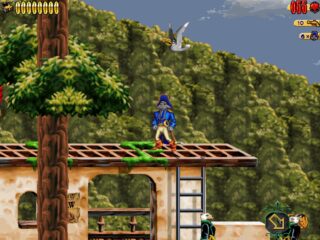





Disney's Tarzan, also known as Tarzan Action Game, is a platformer developed by Eurocom Developments and published by Disney Interactive in 1999 for Windows and PlayStation, with a Nintendo 64 port following later the same year.
Following the tradition of Disney's Aladdin, The Lion King, and Disney's Hercules, Eurocom adapted the animated film — released the same year — into a side-scrolling platformer. The most striking difference from its predecessors is the visual presentation: the graphics are rendered in 3D with filled polygons, giving the jungle environments a depth and lushness that the earlier Disney games couldn't achieve. The movement, however, remains strictly horizontal — this is what is known as 2.5D. The third dimension is purely aesthetic, but it does its job well. The parallax scrolling through the layered rainforest canopy is genuinely beautiful, and the animation captures the film's fluid, acrobatic energy.
The gameplay revolves around Tarzan swinging on vines, jumping across platforms, throwing fruit at enemies, and slamming the ground to uncover hidden areas and break objects. One of the game's highlights is the tree-surfing sequences, where Tarzan glides across branches at speed — a direct recreation of some of the film's most memorable moments, and easily the most distinctive mechanic in the game. The level design is generally well-paced, with bonus stages and collectibles — including letters spelling TARZAN and scattered picture pieces — that add replayability beyond simply reaching the end of each stage. You play mostly as Tarzan, but certain levels let you control Terk, Jane, and Tantor, which adds some welcome variety.
The difficulty is adjustable across three settings, making the game accessible to younger players while still challenging for those who want it. Boss encounters against Sabor and Clayton are among the game's strongest moments. The soundtrack is excellent — the MIDI arrangements closely follow Phil Collins' score from the film, and in some sections it is genuinely hard to tell the difference.
The main weakness is the camera. In levels where the action moves toward the screen, it becomes difficult to judge distances and anticipate hazards — pits and branches can catch you off guard repeatedly until you have memorized the layout. The dark green color palette of some levels also makes it harder than it should be to distinguish solid ground from empty space. These are real frustrations, but they do not undermine a game that is otherwise one of the better Disney platformers of its era.
One technical note: the game was originally built for the 3Dfx Voodoo Glide API. To run it on modern Windows versions, install the nGlide wrapper first — it is free and makes the game run without issues.


 Download for PC
 Download for Mac