

The Last Ninja: The C64 Game That Defined a Generation
 By: Adam
Last updated: 8 March 2026, 9:47 pm



The year is 1987. On the Commodore 64, you load a game from tape. You wait — 25 minutes, in fact. But instead of silence, something extraordinary happens: a haunting, Asian-inspired melody fills the room, flowing from the SID chip with a beauty that stops you in your tracks. By the time The Last Ninja finally loads, you are already completely absorbed. That is the power of this game, and that is why, almost 40 years later, it's still considered one of the greatest titles ever made for the Commodore 64.
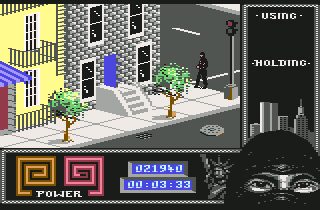
The Last Ninja was designed by Mark Cale, founder of System 3, and released in 1987 during the height of the "ninja fever" that had captured Western popular culture — from movies to arcades to Saturday morning cartoons. System 3 had already shown what they could do visually with International Karate +, but Cale had something far more ambitious in mind: not just a fighting game, but a full action-adventure, with exploration, inventory puzzles, and combat, all rendered in an isometric pseudo-3D perspective that was virtually unprecedented in its depth and scale on the C64.
The inspirations behind the design were telling. Cale had been captivated by Bruce Lee, the 1984 action game released for the Atari 8-bit and Commodore 64, which blended platforming, combat, and light puzzle-solving in a way that felt ahead of its time. He was equally influenced by Adventure, the seminal 1979 Atari 2600 game that first demonstrated the idea of an interconnected world to explore and objects to collect. From Bruce Lee, he took the physicality and the fighting; from Adventure, he took the sense of a world with logic and secrets. The Last Ninja was his attempt to fuse the two into something that had never been done before on 8-bit hardware.

The road to completion was not smooth. The initial development was handed to a Hungarian team called Andromeda, but they couldn't deliver the sprite animation that Cale's design required. Development restarted in-house at System 3, where programmer John Twiddy took on the challenge and made it work — an achievement that still impresses anyone who understands what the Commodore 64's hardware was actually capable of.
The result sold over 4 million copies across all versions, with the C64 version alone accounting for more than half of that. It was a phenomenon.
Armakuni's World
The story is pure ninja mythology. The shogun Kunitoki, fearing the power of the Koga clan, lures all its ninja to Lin-Fen island every ten years and springs a trap. Only Armakuni survives — because he stayed behind to guard the shrine. Learning of his clan's fate, he sets out alone to reclaim the stolen Koga scrolls and take his revenge.
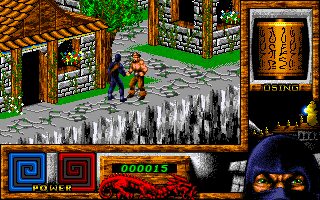
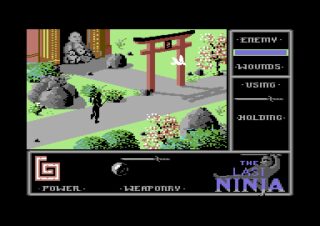
Across six visually distinct stages — Wastelands, the Palace Garden, Dungeons, Palace, Sewer, and Kunitoki's inner sanctum — you guide Armakuni in his quest. Each stage is a set of interconnected screens that you explore freely, searching for items, solving puzzles, and fighting off ninja guards and supernatural enemies alike. Skeletons, ghosts, a dragon lurking by a river — the world of Lin-Fen island builds its own visual identity, a mix of feudal Japan and dark fantasy that feels completely coherent.

The isometric flip-screen approach allows the game to paint remarkably beautiful landscapes. Stepping into the Palace Garden — all floral detail and gentle colour — is a genuine aesthetic pleasure, and the dungeon stages, crawling with rats and ghosts and lit by an eerie chill, are atmospherically superb. For 1987 C64 software, the presentation is extraordinary.
The Combat and the Puzzles
For a game of its era, The Last Ninja offers a genuinely layered experience. Armakuni carries a small arsenal: sword, staff, nunchaku, and shuriken for ranged attacks. Different weapons have different range and power characteristics, and the combat system — while clunky by modern standards — rewards patience and positioning. The classic tactic of luring an enemy into your range, landing a hit, then retreating to recover health is very much part of the design. Fight smart enough, and you might even slip past a guard entirely, causing him to commit seppuku in shame. The game rewards the observant player.

The puzzle layer is equally well-constructed. Each stage revolves around finding and using the right items to progress — a glove before you pick up a rose (bare-handed, the thorns kill you), smoke bombs to put the dragon to sleep, keys and switches hidden across the screens. Shrines scattered through the levels let you meditate to get a hint when you're stuck, a generous and thoughtful touch.
An Honest Note on the Difficulty
It would be unfair not to acknowledge that The Last Ninja is a genuinely hard game in places, and not always for the right reasons. The isometric perspective, for all its visual beauty, creates some practical headaches. Picking up items requires precise pixel-level alignment — Armakuni's crouching pick-up animation must overlap exactly with the object as you see it on screen, not as he would perceive it. It works once you learn the rhythm, but it takes time.

The river and swamp crossing sections, particularly in the first three stages, are the game's most notorious challenge. Jumping between small stepping stones with instant-death water below demands patience and careful input — the C64 version's controls, where pressing in the opposite direction makes Armakuni walk backwards rather than turn around, add an extra layer of complexity to an already demanding task. Many players have lost lives — and more than a little patience — figuring out the exact positioning these sections require.

But here is the thing: these difficulties are part of the experience in a very 1987 way. Players expected games to be hard. They expected to learn through repetition, to die, to figure things out. In that context, The Last Ninja delivers a challenge that feels earned rather than arbitrary, and completing a stage still carries a real sense of achievement.
The Soundtrack
It must be said clearly: the music in The Last Ninja is exceptional. Composed by Ben Daglish and Anthony Lees, the soundtrack comprises six in-game tunes and five separate loading themes — a detail that tells you everything about System 3's ambition. The loading screen music, in particular, became legendary. A calm, meditative Asian-influenced melody that plays while you wait for the game to load, it sets a new standard for what a C64 game could sound like before you'd even pressed a joystick button.

The SID chip — the 6581 sound synthesizer built into every C64 — was already known for producing remarkable music, but Daglish and Lees pushed it into new territory. Each stage has its own score, ranging from the intense rock drive of the Wastelands theme to the chilling ambient atmosphere of the dungeon. The music is not just accompaniment; it is a core part of why The Last Ninja feels like an experience rather than just a game.

It is, in fact, one of the reasons we chose to publish the original Commodore 64 version on GamesNostalgia rather than the later 16-bit ports. The Amiga version — released as Ninja Remix — has improved graphics, but it cannot match what Daglish and Lees achieved on the SID. Some things are simply best left on the machine they were designed for.
Why It Matters
The Last Ninja is one of those rare games that attempted to be more than the hardware allowed — and mostly succeeded. It showed that an 8-bit home computer could host a genuine action-adventure with atmosphere, depth, and artistic ambition. It proved that loading screen music could be part of the experience. It demonstrated that isometric 3D, handled with enough craft, could create a world worth exploring.
It influenced everything that followed it in the series — Last Ninja 2: Back with a Vengeance and Last Ninja 3 both built on its foundations, refining the controls and expanding the formula — and its legacy runs deep in British gaming history.
If you consider yourself a fan of the Commodore 64, or simply of 80s gaming history, The Last Ninja is essential. Load it up, let the music play, and take your time with it. Armakuni is waiting.
You can find it in our Top 20 Commodore 64 Games of All Time, or go straight to the game page and download it for free.
Originally published in 2017. Revised and expanded in March 2026