


GamesNostalgia's Top 20 Commodore 64 Games of All Time
 By: Maddie
Last updated: 18 February 2026, 5:34 pm



The Commodore 64 wasn't just a computer — it was a cultural moment. With its SID sound chip, advanced sprite hardware, and 64KB of RAM, the C64 became the platform where a generation of developers pushed 8-bit computing further than anyone thought possible. Games that shouldn't have worked, somehow did. Experiences that belonged in arcades ended up in living rooms.
Putting together a list of the best C64 games is not a simple task. Thousands of titles were released over the machine's lifetime, and plenty of deserving games didn't make the cut. Our selection is not purely objective — these are the games that left the deepest impression on us, the ones we remember most vividly from those long childhood sessions in front of the monitor. We've prioritised original C64 games where possible, but couldn't leave out titles like Archon: The Light and the Dark, Elite, or Pitstop II that, despite originating elsewhere, became defining C64 experiences.
This list is about technical excellence and personal nostalgia in equal measure — the games that didn't just push the hardware, but created memories that lasted a lifetime.
Originally published in 2025. Revised and expanded in March 2026
20. Leader Board Golf (aka Leader Board)

Access Software's Leader Board Golf brought golf simulation to the C64 in a way nobody had managed before. The game used a clean, intuitive swing mechanic — a three-click system that was simple to learn but genuinely difficult to master — and presented the courses with surprisingly detailed graphics. For many players this was their first experience of a sports simulation that felt realistic rather than abstract, and it held up to hundreds of hours of play.
19. Commando
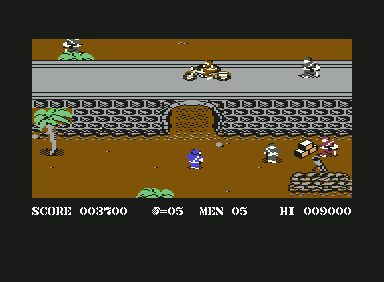
The arcade conversion of Capcom's Commando, developed by Elite Systems, was a masterpiece of adaptation. The game successfully translated the frantic run-and-gun action of the arcade original while adding enhancements that made it feel at home on the C64. The scrolling was smooth, the sprite animation was fluid, and the gameplay was perfectly balanced. The technical achievement was in maintaining the arcade's speed and intensity while adapting the controls for home play. The game's level design and enemy patterns were faithfully recreated, proving that arcade conversions could be more than just pale imitations when handled with skill and care.
18. Gunship (aka Gunship: 21st Century Warrior Apache)
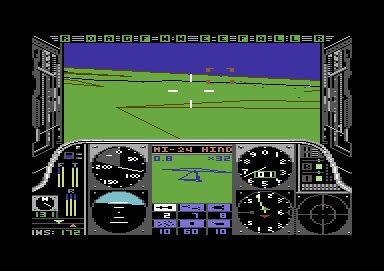
MicroProse's Gunship, designed by Arnold Hendrick and Andy Hollis, brought serious helicopter simulation to the C64. Modelling Apache combat flight with realistic weapons systems, dynamic mission generation, and authentic cockpit displays, it felt genuinely different from the action games around it. The technical achievement was creating a convincing 3D world with workable flight mechanics on hardware that had no business running it. MicroProse had found their formula with titles like this, and Gunship was one of their finest.
17. Pitstop II (aka Pitstop 2)
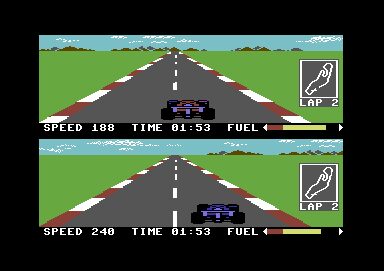
Epyx's Pitstop II, developed by Steven Landrum, was the definitive racing game on the Commodore 64. What set it apart wasn't just the smooth scrolling or the detailed car handling — it was the split-screen two-player mode, one of the first of its kind on a home computer. Racing against a friend while managing pit stops, tyre wear, and fuel created a competitive experience that felt genuinely new. The physics were sophisticated for 1984, and the game held up to the kind of obsessive repeated play that only multiplayer competition produces.
16. The Last Ninja
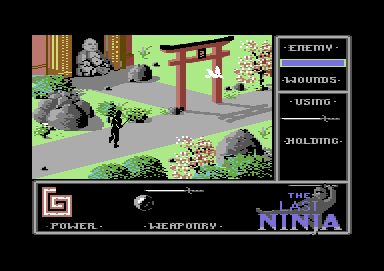
Mark Cale's concept was straightforward: take the interconnected world of Adventure for the Atari 2600, add the physicality of Bruce Lee, and place it all in an isometric environment where the hero is a ninja. Executing that on a C64 was anything but simple — development had to be restarted from scratch when the original team couldn't deliver, and it was programmer John Twiddy who finally made it work. Add Ben Daglish and Anthony Lees's extraordinary SID soundtrack — including five separate loading themes that became legendary in their own right — and you have one of the platform's most complete experiences.
15. Barbarian: The Ultimate Warrior (aka Death Sword)
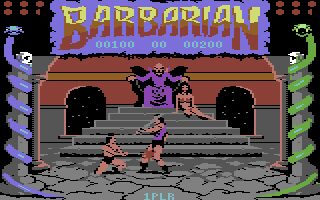
Palace Software's Barbarian: The Ultimate Warrior, created by Steve Brown, is probably best remembered for its controversial marketing, but the game itself was a genuine technical achievement. Large, detailed character sprites with smooth animation brought sword combat to life in a way the C64 had rarely seen. The finishing moves were spectacular for 1987, and the control system — joystick combinations for attacks and defences — gave fights a satisfying physicality. It remains one of the most viscerally enjoyable fighting games on the platform.
14. Laser Squad
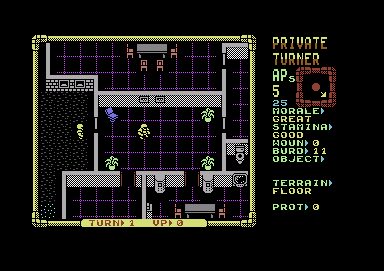
Julian Gollop's Laser Squad, originally created for the ZX Spectrum, found its ideal home on the Commodore 64. This turn-based tactical combat game was the direct precursor to the X-COM series, introducing destructible environments, line-of-sight mechanics, and a depth of strategic play that was unprecedented on home computers. The C64 version benefited from improved graphics and a cleaner interface. Its mission-based structure gave it enormous replay value, and its influence on tactical game design is still visible today.
13. Wasteland
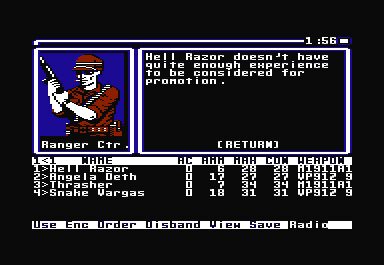
Interplay's Wasteland, designed by Brian Fargo and Michael Stackpole, was a post-apocalyptic RPG that redefined what the genre could achieve on home computers. A vast open world, complex character creation, and storylines that responded meaningfully to player choices made it feel unlike anything else on the C64. The paragraph book system — using external references to extend the story beyond the machine's memory limits — was an inspired solution to a real technical constraint. Its influence on the Fallout series is well documented, and playing it today you can still see why.
12. Summer Games

Epyx's Summer Games, designed by Chuck Sommerville and Scott Nelson, was a technical showcase that exploited aspects of the C64's graphics hardware that few developers had bothered to explore. Released in 1984, it used advanced sprite techniques, smooth scrolling, and detailed character animation to create sports simulations that looked and felt genuinely athletic. Each event pushed different parts of the hardware in different ways. The timing-based gameplay required real skill, and the template it established for sports compilations was followed for years afterwards.
11. Turrican
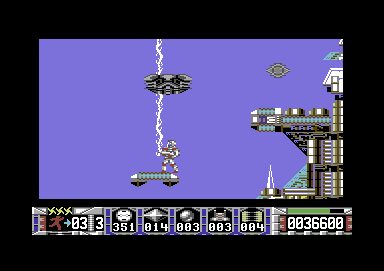
When Turrican appeared in 1990, the reaction was disbelief. Manfred Trenz had created a run-and-gun platformer with huge sprites, smooth multi-directional scrolling, and detailed backgrounds that seemed flatly impossible on the C64. The weapon system, the ball transformation, the sheer scale of the levels — none of it should have worked at this frame rate, on this hardware. Chris Hülsbeck's soundtrack matched the ambition of the visuals. Turrican was one developer demonstrating what the platform was truly capable of, six years into its commercial life.
10. Neuromancer

Based on William Gibson's novel, Neuromancer was developed by Interplay in 1988 and remains one of the most atmospheric adventures on the C64. The game created two distinct worlds — the gritty streets of Chiba City and the abstract geometry of cyberspace — and moved between them with genuine confidence. Timothy Truman's artwork gave the game a visual identity that matched Gibson's prose, and the interface, mixing text and graphics, captured the novel's mood more effectively than anyone had reason to expect. A rare case of a literary adaptation that understood its source material.
9. Impossible Mission

Dennis Caswell's Impossible Mission for Epyx was ahead of its time in almost every respect. Released in 1984, it combined platforming, puzzle-solving, and exploration in a non-linear structure that was genuinely unusual for the period. The digitised speech — "Another visitor... stay a while... stay forever!" — was a technical shock in 1984, and the smooth character animation set a standard that many later games failed to match. The random puzzle generation ensured no two playthroughs were identical, and the time pressure created real tension. Few games from that era have aged as well.
8. Last Ninja 2: Back with a Vengeance

Last Ninja 2: Back with a Vengeance did something difficult: it improved on a game that had already felt complete. Mark Cale's team delivered more detailed environments, smoother animation, and more inventive puzzles than the original, while Matt Gray's soundtrack added a new layer of atmosphere to Armakuni's journey through modern New York. The seamless scrolling and refined controls addressed the original's rougher edges without losing any of its character. For many players, this is the high point of isometric adventure gaming on the C64.
7. Elite

David Braben and Ian Bell's Elite, originally created for the BBC Micro, became something close to a philosophical statement on the Commodore 64. An entire galaxy of 2048 star systems, procedurally generated from 22KB of memory. 3D wireframe graphics running smoothly on hardware with no floating-point unit. A trading and combat system open enough to support completely different playstyles — merchant, pirate, bounty hunter — without ever feeling thin. Elite didn't just prove that the C64 could handle 3D; it suggested that games could be something closer to worlds.
6. Zak McKracken and the Alien Mindbenders
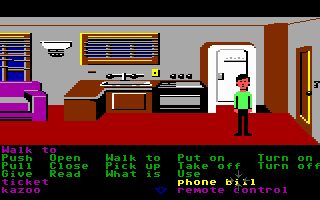
Zak McKracken and the Alien Mindbenders, designed primarily by David Fox with contributions from Matthew Kane, David Spangler, and Ron Gilbert, pushed the SCUMM engine further than Maniac Mansion had. A globe-spanning adventure — Earth, Mars, and beyond — with multiple playable characters, complex puzzles, and a science fiction plot that balanced genuine wit with real invention. The scope was unprecedented for the C64's memory constraints, and the game's combination of surreal humour and careful puzzle design made it one of the finest adventure games of the decade.
5. Archon: The Light and the Dark (aka Archon)
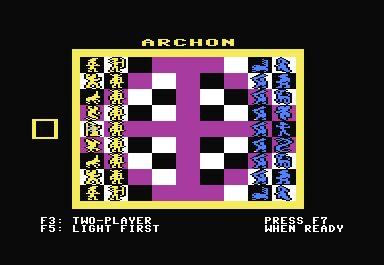
Archon: The Light and the Dark wasn't a C64 original — it was developed first for the Atari 8-bit computers — and that's probably the only reason it doesn't sit higher on this list. The idea of combining chess strategy with one-on-one arcade combat is so elegant it's surprising nobody had thought of it before. Different pieces with different weapons, movement patterns, and abilities. Light and dark sides that play differently from each other. A two-player mode that generated more genuine tactical arguments than almost any game of its era.
4. Turrican II (aka Turrican 2 - The Final Fight)
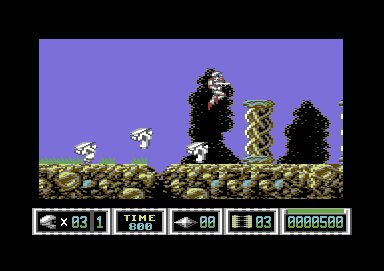
If the original Turrican was a shock, Turrican II was an argument. Manfred Trenz and Andreas Escher pushed every aspect of the first game further — larger levels, more varied enemies, set pieces that nobody had attempted on the platform. Markus Siebold's soundtrack gave the game an epic quality that matched its visual ambition. Technically, Turrican II is probably the most accomplished game ever released for the Commodore 64. The Amiga version is also excellent, but the C64 original came first, and it remains the definitive version.
3. Sid Meier's Pirates!
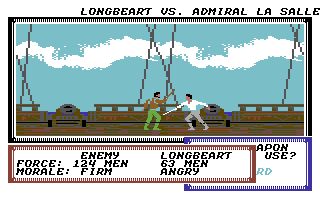
Sid Meier's Pirates! was designed specifically for the Commodore 64 by Sid Meier himself, and it shows — every system feels tailored to the platform's strengths. Strategy, action, role-playing, and simulation blended together around a Caribbean pirate setting that never outstayed its welcome. The persistent open world, the way your character aged and your crew grew or dwindled, the sword fights and the sea battles and the treasure maps — it all cohered into something that felt genuinely alive. The template Pirates! established for open-world game design was still being referenced decades later.
2. International Karate + (aka Chop N' Drop)
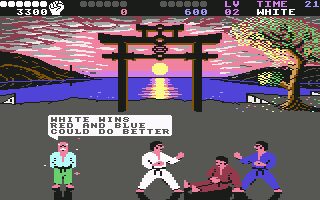
Archer MacLean's International Karate + from 1987 represents the peak of fighting games on the C64. The addition of a third fighter to the original International Karate's formula sounds like a gimmick, but in practice it transformed the game entirely — three-way fights created strategic dynamics that two-player combat simply couldn't produce. The animation was achieved at a fluid 50fps using advanced sprite techniques, and every movement felt weighted and responsive. Rob Hubbard's soundtrack has outlasted the game itself in cultural memory, but the fighting engine it accompanies more than earns its place.
1. Maniac Mansion
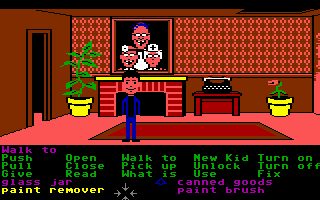
Ron Gilbert and Gary Winnick created Maniac Mansion in 1987, and in doing so invented a new grammar for adventure games. The SCUMM engine replaced typed parser commands with point-and-click verbs, making the genre accessible without making it simple. Multiple playable characters with genuinely different abilities, non-linear solutions, and a dark humour that treated the player as an adult — these were all new. The technical achievement was real: complex character animations, multiple simultaneous storylines, and a scripting system sophisticated enough to support all of it within the C64's memory. But the lasting legacy of Maniac Mansion isn't technical. It's the proof that adventure games could be cinematic, funny, and structurally inventive all at once.