

Treasure: The Studio Behind Gunstar Heroes and some of the Best Genesis/Mega Drive Games
 By: GN Team
Last updated: 25 April 2026, 10:12 am



Treasure Co., Ltd. is one of the most admired independent game studios in Japanese history — a small team that spent the 1990s producing action games of a quality and originality that larger publishers around them rarely matched. Their Genesis catalog alone represents some of the finest software the platform ever saw, and the games available on GamesNostalgia give a clear picture of what made the studio so distinctive.
Treasure was founded in 1992 by a group of former Konami employees who had grown frustrated with their employer's direction. Konami in the early 1990s was a profitable but conservative company, increasingly reliant on sequels and licensed properties. The people who would form Treasure wanted to make original games built around their own ideas. Around 18 developers left to start the new studio, and they chose to work primarily with Sega—a relationship that suited both parties. Treasure found a publisher willing to give them creative latitude; Sega gained a team capable of pushing the Genesis hardware further than most.
GUNSTAR HEROES
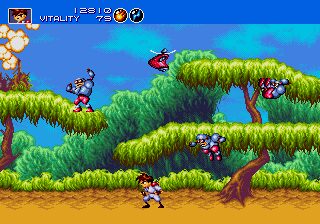
Their debut, Gunstar Heroes (1993), announced the studio's ambitions immediately. It is a run-and-gun that throws an almost overwhelming variety of situations at the player — on-foot combat, rail sections, a dice-board map, a boss fight that lasts longer than some complete games — and holds all of it together with tight controls and a weapon combination system that lets players merge four base weapons into a range of hybrids. The sprite work and the scale of the set pieces were exceptional for the era, and the game pushed the Genesis hardware visibly harder than most contemporary titles. It remains the game most people reach for first when making the case for Treasure.

Also, that year came McDonald's Treasure Land Adventure, a platform game developed on commission — the first example of a pattern that would define Treasure's business model throughout the decade. As a small studio, they relied on revenue from licensed work to fund original projects, and they accepted commissions without ever compromising their standards.
DYNAMITE HEADDY
Dynamite Headdy (1994) followed, a platformer built around a puppet protagonist whose detachable head serves as both weapon and puzzle tool. The game is relentlessly inventive in its stage design, introducing and discarding ideas at a pace that prevents any single mechanic from outstaying its welcome.

The same year saw the release of Yuu Yuu Hakusho: Makyou Toitsusen, a well-regarded fighting game based on a popular anime series, available only in Japan.
ALIEN SOLDIER
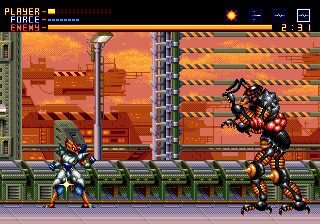
Alien Soldier (1995) is the most demanding of Treasure's Genesis titles and is probably the purest expression of what the studio was technically capable of. It is almost entirely a boss rush — each stage is brief, existing primarily to deliver the player to the next encounter. The bosses have multiple phases and require genuine learning and adaptation.

Sega of America declined to release it in the United States, citing it as too difficult for the western market; it was eventually made available via the Sega Channel subscription service. Also in 1995 came Light Crusader, an isometric action RPG that represented a deliberate change of pace — slower, more exploratory, and aimed at a broader audience than Alien Soldier's uncompromising challenge.
As the Genesis era wound down, Treasure moved to the Sega Saturn. Guardian Heroes (1996) expanded its repertoire into the beat-'em-up genre, combining it with RPG elements and a branching narrative.
RADIANT SILVERGUN
Radiant Silvergun (1998) stands apart from everything else in Treasure's catalog. Released first as an arcade game before receiving a definitive Sega Saturn port, it was the studio's first proper shoot 'em up, and the results suggested they had been thinking about the genre for years before attempting it. The game gives the player six weapons simultaneously — three primary and three combinations — each earning power through use rather than pickups, meaning a player's arsenal at the end of a run is a direct reflection of how they played.

The scoring system reinforces this further: enemies come in three colors, and chaining kills of the same color multiplies points, which, in turn, drives weapon growth. Nothing is throwaway; every encounter is an investment. The Saturn version adds a full story mode with a narrative ambition unusual for the genre — a cyclical, darkly apocalyptic plot that drew obvious comparisons to Neon Genesis Evangelion — and a save system that carries weapon levels across sessions, giving the game the accumulative quality of an RPG. Hitoshi Sakimoto's orchestral soundtrack, more reminiscent of his work on Final Fantasy Tactics than anything associated with shoot-'em-ups, completes the picture. Radiant Silvergun remains one of the most sophisticated games Treasure ever made, and one of the most admired shoot 'em ups in the history of the genre.
ASTRO BOY: OMEGA FACTOR
When the studio expanded to Nintendo hardware in the early 2000s, they brought the same approach with them. On the Game Boy Advance, Advance Guardian Heroes revisited the Saturn original, while Gunstar Super Heroes returned to the world of their debut. Astro Boy: Omega Factor, developed in collaboration with Hitmaker, applied Treasure's action design to Osamu Tezuka's classic manga universe with considerable success.

All of Treasure's Genesis work was produced during a period of exclusive alignment with Sega, before the studio broadened its platform reach. They are products of a particular moment — a small team with something to prove, working on hardware they understood deeply, making games they wanted to play. That combination produces a specific kind of quality that is difficult to manufacture and impossible to fake.
The games Treasure made for the Genesis are available on GamesNostalgia, including Gunstar Heroes, Dynamite Headdy, and Alien Soldier. For a broader look at the platform, the Top 20 Sega Genesis Games of All Time is a good place to start.