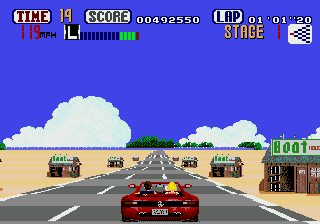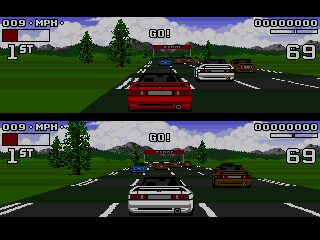





Continental Circus is an arcade racing game originally developed by Taito and released in arcades in 1988. The Amiga and Commodore 64 versions were published by Virgin in 1989, with the Amiga conversion developed by Teque Software.
The game was originally titled Continental Circuit, but a mistranslation somewhere along the way turned it into Continental Circus — a name that stuck, and that many argued actually suited the spectacle of Formula 1 rather well. The arcade cabinet was one of the most innovative of its era, featuring true stereoscopic 3D: players viewed the screen through special LCD glasses that flickered at high speed to create a genuine three-dimensional effect. Playing for extended periods was said to cause headaches, and arcade owners reportedly did a brisk trade in painkillers. None of this translated to the home versions, of course, but what did translate was the fast and addictive gameplay that made the arcade original such a hit.
The game puts you in a Formula 1-style car racing across eight real-world circuits, starting in Brazil and finishing in Japan, passing through Monaco, Germany, and other famous venues along the way. The goal is not necessarily to win, but to achieve a qualifying rank — you start in 100th place and must overtake enough cars to reach the required position before the time limit expires. Fail to qualify and you lose a credit.
Contact with other cars or track-side obstacles sets your engine smoking. If you reach the pits in time you can repair the damage, but a second collision while already smoking sends the car spinning and exploding in a fireball. Rain appears on later circuits and significantly affects handling, requiring wider cornering lines and more careful throttle control — particularly brutal in Monaco.
The Amiga version received strong reviews at the time, with Amiga Computing awarding it 91% and praising it as one of the finest arcade conversions available on the platform (but remember it was the 1989 so it was before Lotus Esprit Turbo Challenge). The graphics are fast and smooth, with large, crisp car sprites that convey a genuine sense of speed. Sound is the weak point across both versions — a basic engine drone with little variety — but in a game this fast and addictive, it is easy to overlook. The Commodore 64 version is slightly slower but still very playable.
Continental Circus is not a deep or realistic racing game — cornering rarely requires braking, and the AI is not particularly sophisticated. But like the old classics like Pole Position or Pitstop II, it captures the breathless pace of the arcade original with real flair, and remains one of the most enjoyable Formula 1 arcade conversions of the late 1980s.


 Download for PC