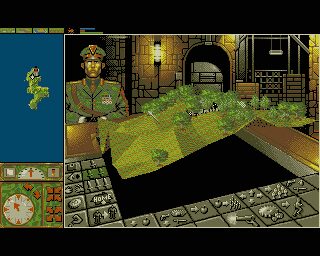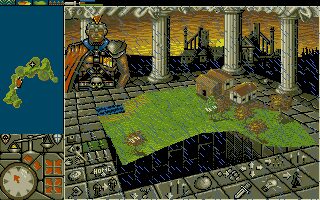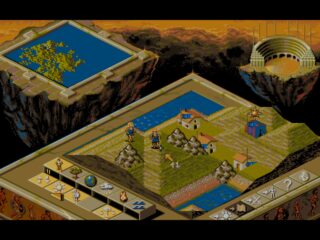





Set in a medieval fantasy world, Realms puts you in the role of a warlord who must conquer territories, manage cities, and command armies in tactical battles. The game occupies an interesting position between god game and real-time strategy, creating a hybrid that anticipates by nearly a decade mechanics that would become popular with the Total War series.
The gameplay is divided between managing conquered cities and tactical combat on the battlefield. You must balance resources, keep conquered populations happy, and prevent revolts that can break out if you neglect your domains. Newly conquered cities are particularly unstable and require constant attention, though reconquering them is generally quite straightforward. The playfield interface resembles that of Populous and Mega lo Mania, with an isometric view that allows you to observe the territory and plan your moves.
Where Realms truly excels is in atmosphere. The graphics create a believable and fascinating fantasy environment, with castles, forests, and mountains rendered with care for the Amiga. But it's the soundtrack that elevates the experience to another level - the music is simply extraordinary, creating an epic and immersive atmosphere that completely draws you into the game's medieval world. It's rare to find a 1991 title with such evocative audio.
The game isn't without flaws - the learning curve is steep, and the interface can be daunting initially. Some aspects of city management could be deeper, and after several hours, the gameplay can become slightly repetitive. However, for strategy fans willing to invest time in learning the mechanics, Realms offers a rewarding experience.
Compared to contemporaries like Powermonger or Centurion: Defender of Rome, Realms stands out for its unique atmosphere and ambition to blend management elements with tactical combat. It's not perfect, but it represents a bold experiment that deserves respect for anticipating ideas that would become standard in the strategy genre years later.


 Download for PC
  Download for Mac