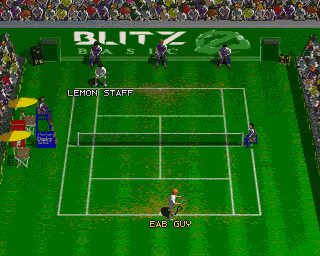





The tennis gameplay itself is solid and enjoyable. Viewed from behind the court in a pseudo-3D perspective, the game supports singles and doubles matches, with a second-player option that makes multiplayer fun. You choose from a roster of characters based on real tennis players of the era — including Boris Becker, John McEnroe, and Ivan Lendl — though the differences between them are largely aesthetic rather than statistical. The controls are simple: the directional pad moves your player around the court, and two face buttons produce different shot types — a powerful drive and a higher lob. Serving can be tricky, with the power shot producing frequent faults until you learn the timing, but the ball physics feel noticeably more natural than in many console tennis games of the period, allowing for dynamic rallies and proper baseline play. Compared to Super Tennis on the SNES or Super Tennis Champs on the Amiga, World Court Tennis has a more arcade-like feel, while Final Match Tennis — also on the PC Engine — offered a somewhat more simulation-oriented alternative on the same hardware.
What truly sets the game apart is the Quest mode. After naming your character and choosing their gender, you are dropped into a top-down RPG world map that looks remarkably like Dragon Quest or early Final Fantasy titles. You wander between towns, speak to NPCs for clues, buy equipment upgrades — better rackets, shoes, and clothing — and travel across the map. Random encounters appear as you explore, and when one triggers, the game switches to a tennis court where you must beat your opponent to continue. Win, and you earn money for upgrades; lose, and you are sent back to the starting town. The RPG elements are light — there is no experience system or leveling up — but the combination of tennis mechanics with an overworld adventure structure is genuinely charming and surprisingly immersive.
The visuals are among the best on the TurboGrafx-16, with fluid character animations that make court positioning feel responsive. The overworld map in Quest mode has a lovely classic RPG aesthetic. The soundtrack is the weakest element — limited in variety and fairly basic —, but it does not detract significantly from the experience.
World Court Tennis received very positive reviews at the time and remains a hidden gem on the platform. The combination of accessible tennis gameplay and the unexpected RPG layer makes it one of the most memorable and original sports games of the late 1980s.


 Download for PC