
Retro games, abandonware, freeware and classic games for PC and Mac


Author: GN Team - Published: 29 January 2020, 8:11 pm
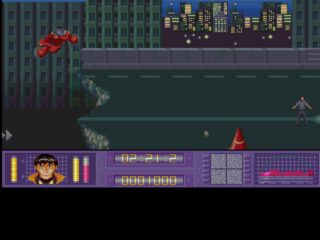
Akira is an action game developed by International Computer Entertainment and released in 1994 for the Amiga. It's based on the 1988 Akira film.
Sadly, the game is one of the worst commercial games ever created for the Amiga, with scores such as 6/100 by The One Amiga, 16% by Amiga Power, and 18% by Amiga Format. It also has a rating of 1.8 on Lemon Amiga.
But if you want to see for yourself how the game is, there you go!
Read More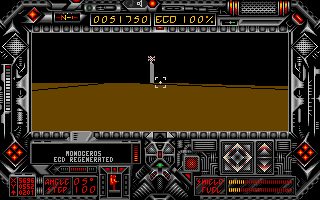
Author: GN Team - Published: 28 January 2020, 10:33 pm
Dark Side is a first-person 3D space action game created by Incentive Software in 1988 for 8-bit and 16-bit platforms. The title was released for ZX Spectrum, Atari ST, Amiga, and Commodore 64.
The title uses the game engine developed internally by Incentive, called Freescape, to create a complete 3D environment, with objects rendered as polygons and the ability to look up and down. This is the second game to use this engine after Driller, the precursor to Dark Side.
In this game, you are a government agent who aims to destroy a terrible weapon on the moon. The beam gun is a kind of Death Star that some terrorists want to destroy a planet (not very original, I know).
Read More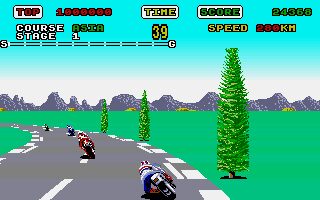
Author: GN Team - Published: 25 January 2020, 4:11 am
Super Hang-On is a motorcycle racing coin-op created by SEGA and released in 1987. It was ported to many platforms in the following years, including Amstrad CPC, Commodore 64, Atari ST, and ZX Spectrum.
It was the sequel of Hang-On, another coin-op released two years before. Both games were designed by the legendary game creator Yu Suzuki, also known for OutRun, After Burner, and many other successes.
The Amiga version of Super Hang-On, released in 1988, was developed by Software Studios, and it was one of the most appreciated (and one of the most faithful ports).
Read More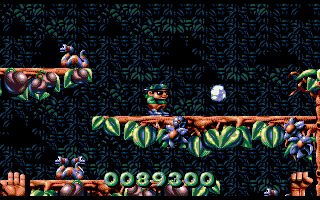
Author: GN Team - Published: 23 January 2020, 10:48 pm
Magic Pockets is a platformer created by The Bitmap Brothers and published for Atari ST and Amiga in 1991 by Renegade Software.
It was also ported to PC, Acorn 32-bit, Genesis/Mega Drive, and other platforms.
The Bitmap Brothers are well known for several legendary titles such as Gods and Speedball. Magic Pockets is one of their less-known creations. Even if nobody will consider it the best platformer ever created, it has excellent graphics, good sounds, nice intro music (pity that there is no music during the game, probably the only big flaw), and very original ideas.
Read More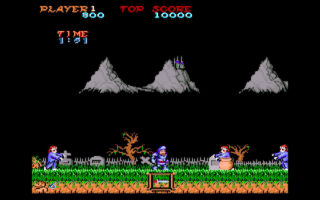
Author: GN Team - Published: 19 January 2020, 9:35 pm
Ghosts 'N Goblins is a popular arcade game released by Capcom in 1985 and later ported to many home platforms.
The Amiga version was published by Elite in 1990, several years after the original Capcom coin-op. It was released a few months after the release of the sequel, Ghouls 'N Ghosts, by US Gold.
The legendary platformer featuring Sir Arthur trying to survive the demons' village was designed by Tokuro Fujiwara (also the author of Commando and many other games). The arcade game was released in 1985 and ported to many home computers and consoles. The Commodore 64 was probably the best until, 5 years later, the Amiga version was finally out. Graphics, music, and gameplay are the most faithful you can expect. This is universally considered the best port of Ghosts 'N Goblins. Unfortunately, the difficulty level is also quite faithful, which means the game is almost impossible unless you use the options provided in the package: unlimited lives, invulnerability, unlimited time, and more. The NES port of Ghosts 'N Goblins is considered one of the best 20 NES Games ever created.
Read More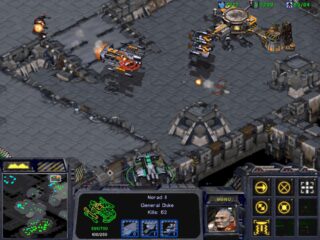
Author: GN Team - Published: 18 January 2020, 2:54 pm
StarCraft is a real-time strategy game developed and published by Blizzard Entertainment, released in 1998 for Windows. It was later ported to Mac OS. The game was designed by Chris Metzen and James Phinney, and produced by a team of around twenty people at Blizzard.
The concept for StarCraft emerged after the completion of Warcraft II: Tides Of Darkness. Rather than making a direct sequel, Blizzard's team wanted to explore a science fiction setting — partly inspired by the success of the Command & Conquer franchise, which had proven that military and gritty settings could work well in the RTS genre. The decision to go sci-fi was, according to Metzen, also a deliberate reaction to the Warcraft series, with a desire to create something more grounded and realistic in tone. Interestingly, Blizzard briefly considered making a Star Wars-themed RTS in collaboration with LucasArts, but those talks never came to fruition.
Read More