

Pirates! and Pirates Gold: Still the Greatest Pirate Games Ever Made
 By: GN Team
Last updated: 15 March 2026, 10:29 am



In 1987, Sid Meier made a pirate game based on children's picture books and Errol Flynn films. It became MicroProse's best-selling game of the year, introduced the design philosophy that would later produce Sid Meier's Civilization and Sid Meier's Railroad Tycoon, and put Meier's name on the box for the first time. Six years later, MPS Labs rebuilt it from the ground up as Pirates! Gold — adding VGA graphics, a full orchestral soundtrack, and enough new features to make it feel like a different game. The result is one of the finest remakes in gaming history, and the version most players encountered and remember.

The origin of Sid Meier's Pirates! is one of gaming's better stories. Shortly after completing F-15 Strike Eagle and Silent Service, Meier took a vacation to the Caribbean with his girlfriend. She called his business partner, Wild Bill Stealey, in a panic after losing track of him for several days. Meier hadn't drowned — he had simply become so absorbed in the museums and relics documenting the age of Caribbean buccaneering that he had forgotten he was on holiday. He came home with a game already forming in his mind.
The project had actually begun at MicroProse as a rigorous simulation of Age of Sail naval combat, designed by Arnold Hendrick and modelled on the Avalon Hill board game Wooden Ships and Iron Men. Hendrick couldn't make it work and moved on to Gunship instead. Meier picked up the idea and approached it in an entirely different way. His reference material was not historical texts but children's books and pirate films. "The player shouldn't have to read the same books the designer has read," he said. The point was to capture the *feeling* of piracy — the sword fights, the ship battles, the treasure maps, the evil Spanish governor — not to simulate its grim realities.
Stealey was unconvinced. He had spent years building MicroProse as makers of military simulations, and here was his star programmer proposing a pirate game inspired by illustrated children's books. He eventually yielded — Meier could be astonishingly stubborn — but remained uncertain enough about its commercial prospects that he was already talking up the next project in interviews given just before the game's release. Pirates! defied his misgivings to become MicroProse's blockbuster of 1987, joining F-15 Strike Eagle, Silent Service, and Gunship as one of the company's most reliable long-term sellers.
Gameplay
Pirates! is famously difficult to describe. The back of the box calls it an "action-adventure simulation," which is kind of true, but it doesn't explain anything. In practice, it works like this: you command a pirate ship in the Caribbean between 1560 and 1680, choosing your nationality, your starting era, and a special skill that shapes your entire playthrough. From there, the game is entirely open.

You sail between colonies, trading goods, gathering intelligence in taverns, and managing your crew's loyalty with a steady supply of plunder and pay. The European powers — English, Spanish, Dutch, French — are in shifting alliances, and your standing with each one determines where you can dock safely and who will send privateers after you. Governors offer missions; treasure maps lead to buried gold; your four enslaved family members are scattered across the map waiting to be tracked down through a chain of clues.
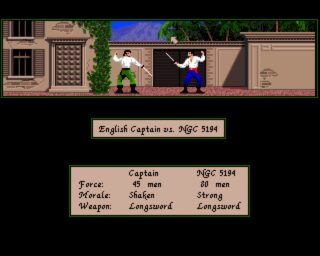
When conflict arrives, you drop into one of three action sequences. Sea battles have you manoeuvring your ship against another, using wind direction to gain advantage, firing broadsides until you can ram and board. Land battles pit your crew against a colony's garrison. And sword duels — the most frequent and most satisfying — are decided one-on-one with your choice of rapier, longsword, or cutlass, using attack and parry moves in real time. Victory in the duel ends the fight regardless of crew numbers. You can be outnumbered ten to one and still win by beating the captain.

Not everything in Pirates! is about violence and plunder. Each colonial governor has a daughter, and courting her is one of the game's most charming subplots. After a successful raid or a completed mission, you may be invited to a ball at the governor's mansion, where a dancing mini-game determines how well you impress her. The better your performance — and your reputation — the warmer her reception. Court her well enough across multiple visits, and she may eventually agree to marry you, which counts toward your final score and adds a genuinely romantic thread to an otherwise swashbuckling adventure. It is one of the details that sets Pirates! apart from every other game of its era: a pirate game where diplomacy, charm, and dancing matter as much as cannon fire.

You age throughout the game. Your reflexes slow; your crew grows restless if not paid in treasure; eventually, retirement becomes the only sensible option. Your final score is calculated from the wealth, land, and titles you've accumulated — from a common beggar up to the King's advisor, depending on how well you played.
The result is a game that has no genre equivalent even today. Everything feeds into everything else: the sailing simulation informs the sea battles, the trading economy shapes which governors will help you, and the family rescue storyline gives the open world a personal stake. The game is, as Meier openly acknowledged, almost comically forgiving by the standards of its time. The living world — territories changing hands, prices fluctuating, your missing relatives scattered across the map waiting to be rescued — adds depth without imposing punishment.
Its most obvious influence was Seven Cities of Gold, Danielle Bunten Berry's accessible exploration game set in the Americas, which Meier has cited often. Pirates! borrowed its menu-driven controls, its open map, and its sense of a living world that continued with or without your involvement. Meier's own view was that Pirates! improved on its inspiration by giving the player more concrete goals and greater variety — the journey more satisfying, the world more populated with things to do.
The Many Versions of Pirates!
The original Sid Meier's Pirates! launched on the Commodore 64 in 1987. It is a technical marvel for the platform. The Commodore 64 original remains remarkable for what Meier achieved within 64K. The disk loads are fast; the windowed interface is clean and elegant; the action sequences are responsive. Jimmy Maher, who has written about it at length, calls it "the greatest game ever born on the little breadbox." The technical craft is inseparable from the design achievement — the game works partly because of the hardware constraints, which forced Meier to strip everything back to essentials.
The game was quickly ported to Amstrad CPC (1987) and Apple II (1988), both with graphics very similar to the C64 original, but with worse gameplay.
The more interesting ports came later. The Atari ST version (1989) and especially the Amiga version (1990) represent a significant visual upgrade, with richer colours, more detailed artwork, and improved music. The Amiga version has the best graphics of all the original game's versions, and it has aged remarkably well. There was also a Macintosh version with elegant black-and-white graphics that perfectly suited the platform's aesthetic — understated yet surprisingly atmospheric.

The DOS version of the original Pirates! by contrast, uses ugly CGA graphics, and it is the weakest-looking release in the entire series. The NES version (1991) is a notable exception to the rule that console ports of PC games were inferior. Rather than following the C64 version, it draws more heavily on the Amiga release for its visual style. It was a well-made port.
Pirates! Gold: What Changed in the 1993 Remake
MPS Labs released Pirates! Gold in 1993 for DOS, with a Windows 3.x version following in 1994. The core gameplay is identical to the 1987 original, but almost everything around it has been rebuilt.
The most immediately striking change is the visual presentation. Pirates! Gold for DOS uses VGA graphics with a rich, warm palette that reviewers described as having a Baroque painting quality — detailed portraits, atmospheric lighting, and a visual style that suits the Caribbean setting far better than anything that preceded it. The sea battle and sword duel screens are dramatically improved: ship health indicators and captain status are now visible at a glance, removing much of the guesswork of the original. An in-game map displays all colonies and their current ownership. A turbo mode on the overhead sailing map makes long ocean crossings significantly less tedious.

The soundtrack is the other major upgrade. Where the original had minimal music, Pirates! Gold has a full orchestral score. The overall audio atmosphere is an improvement, even if a handful of sound effects — the noise when hit during a sword duel, most notoriously — feel tonally misjudged.
New gameplay content includes additional mission types from governors, new characters to interact with in colonies, and expanded options throughout. The overall difficulty is noticeably lower than the original, partly due to the visual aids and partly to design adjustments — worth noting if you find the 1987 version punishing.
The controls are Pirates! Gold's significant weakness. The game uses a mixed mouse-and-keyboard scheme that the manual itself acknowledges is imperfect, recommending the keyboard over the mouse in several sections. Sword duels, in particular, feel clumsy with a mouse, unlike the original's joystick and keyboard controls.

Pirates! Gold also has a stricter save system than the original: you can only save in port, rather than anywhere on the map. And the original 1993 release shipped with game-breaking bugs that caused crashes; the patched version is more stable but still occasionally unstable.
The Genesis/Mega Drive and Amiga CD32 versions, both released in 1994, have an entirely different visual approach. Where the DOS version adopted a serious, painterly aesthetic, the console versions went in the opposite direction — bright, vivid cartoon-style pixel-art that is colourful and immediately appealing. They are arguably more fun to look at; they are certainly more cheerful. Beyond the visual difference, the console versions benefit from gamepad-native controls that handle the sword duels and sea battles more intuitively than the mouse-and-keyboard scheme of the DOS version.

The Amiga CD32 version adds CD-quality music, making it the best-sounding release in the entire series. If you want Pirates! Gold's content with better controls and a more exuberant visual style, the console versions are a legitimate alternative rather than a lesser substitute.
Which Version Should You Play?
The answer depends on what you want from the game.
* Sid Meier's Pirates! (C64, 1987) — Meier's original on the Commodore 64 is a technical marvel, everything the game needs crammed into 64K with snappy disk loads, clean graphics, and responsive controls. The Amiga port (1990) improves on it with richer music and better visuals while keeping the same tight design. If you want to understand what Meier actually built, you can choose one of the two. They are both available on GamesNostalgia.
* Pirates! Gold (DOS, 1993) — The version most players remember, and the recommended starting point for anyone coming to the series for the first time. The visual and audio upgrade is substantial; the new quality-of-life features make the game more approachable; and despite the control quirks, the core experience is as good as it ever was. Use the keyboard for duels. Save often.
* Pirates! Gold Amiga CD32 or Genesis (1994) — Worth seeking out if you want the remake's content with better controls and a completely different visual personality. The cartoon-style graphics are vibrant and fun, unlike the painterly DOS version, and the gamepad controls make the action sequences feel more natural. The Amiga CD32 version adds a better (smaller) font and CD-quality music. It is the best-sounding release in the entire series, but it's not easy to play with an emulator. You can download the soundtrack separately from GamesNostalgia.

Legacy and Influence
Pirates! Gold sold less well than the original — partly due to the launch bugs, partly because many players mistook it for a minor sequel rather than a ground-up remake. The 2004 3D remake, Sid Meier's Pirates!: Live the Life, reached a larger audience but divided fans of the originals.
The influence of the 1987 design, however, has been immense. The open Caribbean world, the faction reputation system, the blend of naval strategy and action mini-games — all of it can be traced in Assassin's Creed IV: Black Flag, Sea of Thieves, and a long chain of pirate games in between. Pirates! was also a template for Meier's own future work: the topic-first design philosophy it established — choose an interesting subject, then find the genre that serves it best — ran directly into Sid Meier's Railroad Tycoon and Sid Meier's Civilization.
It was also the game that made Sid Meier famous. Stealey had been sitting at dinner with Robin Williams at a Software Publishers Association event when Williams observed that there were film stars and sports stars but no software stars. Stealey's response was to put Meier's name on the box. Pirates! was the first game to carry the "Sid Meier's" prefix — a label that would eventually be attached to games he had little involvement in, but which began here, with a pirate game born from children's books and a lost afternoon in a Caribbean museum.
For more on Sid Meier's approach to historical simulation, see Sid Meier's Colonization.