

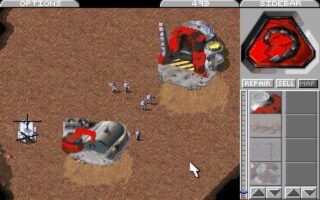




Command & Conquer is a real-time strategy game developed by Westwood Studios and published by Virgin Interactive in 1995 for MS-DOS. It was later released for Windows 95 and also came to several consoles.
The game was designed by Brett W. Sperry, Joseph Bostic, and Eydie Laramore. Bostic had also co-designed Dune II with Aaron E. Powell, which makes the lineage between the two games even more direct — this was the same creative mind refining and expanding on the formula he had helped invent. In fact, Command & Conquer was built directly on the foundation laid by Dune II, which Westwood themselves had created just two years earlier and which defined the real-time strategy genre. But where Dune II: The Battle For Arrakis was tied to a licensed universe, C&C introduced an original science-fiction setting: a global conflict between the Global Defense Initiative (GDI) and the terrorist organization Brotherhood of Nod, fighting over a mysterious alien resource called Tiberium.
The gameplay follows the formula that would define RTS games for years: harvest resources, build a base, train units, and destroy your enemy. What made Command & Conquer stand out was its pace. Matches felt faster and more aggressive than WarCraft: Orcs & Humans, which Blizzard had released the same year. The two games competed directly for the same audience, but C&C had a grittier, more cinematic feel thanks to its full-motion video cutscenes featuring live actors — a production choice that was unusual and expensive for its time.
The two playable factions are genuinely different. GDI is the straightforward choice: heavy tanks, strong infantry, and a playstyle that rewards building a solid base and pushing forward with force. Nod is more interesting for experienced players — faster and cheaper units, a focus on stealth and guerrilla tactics, and access to the iconic Stealth Tank. This asymmetry gave the game real depth and encouraged you to play both campaigns.
The game shipped on two CDs, one for each faction, and each campaign told the story from a different perspective. This was a smart design decision that added replay value and helped players feel connected to whichever side they chose. Multiplayer was also supported, which in 1995 was still far from standard for PC games.
Visually, the game used a top-down 2D perspective with sprite-based graphics. Nothing technically groundbreaking, but the unit animations were smooth, and the battlefield was easy to read at a glance. The music, composed by Frank Klepacki, became one of the most memorable soundtracks in gaming history — with tracks like Hell March that are still widely recognized today.
Command & Conquer was a massive commercial success, selling over three million copies. It launched one of the most beloved strategy gaming franchises and directly influenced the games that followed, including Starcraft and Age of Empires. The series continued with Command & Conquer: Red Alert in 1996, which expanded the universe into an alternate-history setting and is considered by many fans to be even better than the original.
The game holds up well. The controls are simple, the missions are varied, and the two-faction structure gives you a good amount of content. If you've never played it, this is one of the essential classics of PC gaming.


 Download for PC
 Download for Mac